Showing posts with label Tool Maintenance. Show all posts

Saturday, July 28, 2012

I'm Guilty, Too

Keep your tools clean!  And keep them sharp if that is one of their features.  That's the ideal, and many of the Things I get to do today are about the ideal.   The ideal is great, but then there's real life.

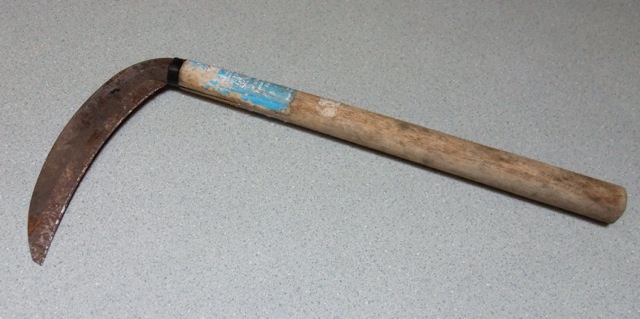
Ugly and not fit to use


A blog follower admitted with embarrassment in response to a post last fall:  I don't take care of my tools.  Just so you know, blog follower,  I don't take very good care of mine either.

All better.  Now it just needs to be activated
by a good strong arm and some determination.


I found this pathetic weed sickle in the shed the other day.  An hour or so later, it was pulled back from the brink of hideous and can now be used again.  Nobody's perfect.  I'm guilty, too.


Sunday, March 25, 2012

Get a Grip

Everybody's eager to get cleaned up
I recently read this "high and mighty" blog about keeping ones tools in good condition--it got me thinking.  And while prettying up the garden paths yesterday, I picked up my "loop hoe." I recoiled instantly.  Ick!  Aack!  The handle was prickly with tiny, furry slivers.  Gloves allowed me to finish my job, but "tend the tool handles" went right up to the top of the Things I get to do today--as in NEXT.


Slivery and nasty to touch,
Much like finger nails on a blackboard


This is a two-person job, it turns out. One person holds the hoe (shovel, rake and pitchfork all got in line right away as well) and rotates it slowly. The other person guides the belt sander back and forth. All the old gray comes right off!  But the loop hoe is still furry and nasty to touch.


A light sanding with finer grit paper is the obvious solution. What does a sanding block for a tool handle look like?


Use a 4" long piece of 3/8" thick foam pipe insulation.  Fold the sandpaper in half and secure it with double-sided tape.  Stuff it into the foam and sand away.  It takes a little practice finding the right grip, but you'll get it.
Lined up by age.  Oldest at the top--Shovel, then rake, pitchfork.
Loop hoe at the bottom--the newest tool.

A generous coating of waterproof wood protector, half an hour in the sun, and another light sanding and they are done.

An interesting observation from this task:  The shovel is perhaps 70 years old.  The handle was gray and silky smooth to touch before this work.  The loop hoe is less than 10 years old, and its handle is barely acceptable to the hand even now.


Thursday, March 15, 2012

Trusty or Rusty Tools

A superb crew works for me.  The success of my projects depends on that team.  When they show up, smart, well-dressed, strong, and well honed, there is little that can stop us.  That's how I like it.

The "crew" are my tools.  The team varies and is always being fine tuning, being assembled from the best I have--my 10" Makita Compound Miter Saw, a tape measure, a good screwdriver with variable tips, a Makita cordless drill, a hammer (borrowed from my husband), and a tri-square/level.

Before cleaning
The tri-square appeared awhile back on our workbench though we can't remember from where.  My husband's tri-square, as it hangs on the pegboard above the workbench, is shiny new-looking. This come-lately one is crusted, rusted and unappealing.  For the woodshed venture, I picked the gnarly one--thought I'd give it a little workout and attention on the job.  It worked well enough to line up those roof boards and give me straight/square lines when I was measuring lumber.  And I didn't mind getting it wet.


After

I want to prove a point to myself as one of the Things I get to do today: Shiny, clean tools work better than rusty, dirty ones.  That means for this tri-square to stay on the job with me, it needs to clean up its act. Since I'm responsible for my crew, I need to clean up its act.  During the steel-wooling of the ruler section, I pondered my hypothesis about clean vs. rusty. The marks on the rule do not change with the surface condition; however, it is harder to adjust accurately if it's rusty. So the tool actually does work slightly better when it's clean.

More important, however, is how one feels when using the tool.  Frustrated, unsure, fumbling, grumpy, impoverished, unclear; or confident, abundant, masterful, accomplished, smart, professional?   The thought and the attitude of the person determines how skillfully the tool is used. I work better when I wear makeup, and I work better when my tools look sharp and work well.

One final observation:   Look-like-new can be kept that way.  Maintain your crew and they'll work faithfully for you forever. You don't want the "before" and "after" labels above to be reversed.  Few tools can be salvaged as easily as this vintage Stanley Handyman No.H1222 1/2.